
Reviewed · REYKJAVIK WALKING & FOOD TOURS
Reykjavik: Guided Folklore Walking Tour
Reykjavik’s old stories are full of elves, trolls, ghosts, and sea monsters, and this walk gives them a proper setting: graveyards, quiet streets, Lake Tjornin, and the oldest part of town. The guide adds Icelandic magic, runes, songs, and tales of the 13 Yule Lads, so this is more than a standard city stroll.
I like the strong storytelling and the way the tour uses real places instead of treating folklore as a museum display. I also like the manageable 1.5-hour length, its central start and finish, and the chance to hear personal touches from guides such as Einar, Stefan, Magnus, and Oli. The main caution is simple: some ghost tales and stories about Grýla, the child-eating troll, may frighten small children.
Key points to know before you book
- Folklore with a real city setting: Hear stories at graveyards, beside Lake Tjornin, and around central Reykjavik.
- The ghost stories can be genuinely creepy: The Deacon of the Dark River and other tales add a sharper edge than a gentle family story hour.
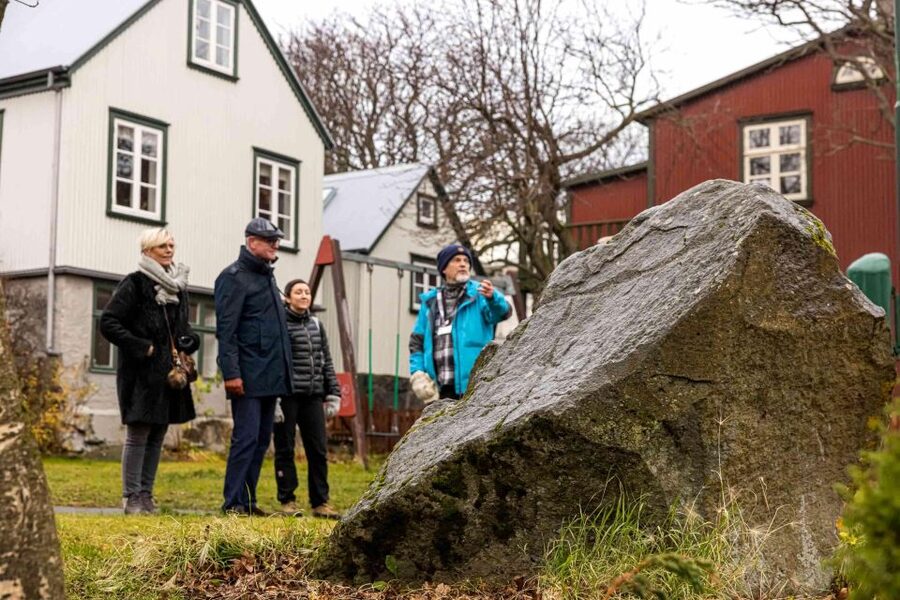
- You see an elfstone in the city center: The tour connects old beliefs with modern Reykjavik.
- The guide matters here: Strong performers such as Einar and Stefan use humor, acting, songs, and audience interaction.
- The walk is short but outdoors: Plan for wind, rain, snow, and changing Icelandic weather.
- It suits curious adults and older children best: Younger children may find parts of the tour scary.
Why Reykjavik folklore works so well on foot
Iceland is often called the land of the sagas, and this tour shows why storytelling still feels tied to daily life here. The tales are not presented as dry mythology. They are told as stories attached to places, family traditions, weather, darkness, and the strange shapes of Iceland’s natural world.
You hear about the hidden people, the Icelandic name for elves and other unseen beings. You also hear about trolls, ghosts, monsters that live mostly in the water, old runes, and magical practices. The result is part walking tour, part ghost story, and part introduction to the imagination behind Icelandic culture.
That mix is the real appeal. If you only want a factual tour of Reykjavik’s buildings, this may feel unusual. If you want to understand why elves, trolls, and old sagas still appear in Icelandic conversation, the format makes sense.
The guide’s performance is central. Einar is known for bringing stories to life with humor, personal connections, folk songs, and a strong sense of timing. Other guides, including Stefan, Magnus, Oli, Beau, and Bo, have also been praised for their warmth, comic acting, and storytelling.
You may hear a song or a lullaby. You may be asked to think about whether a monster tale is true. You may even learn a few bits of Icelandic magic. This is not a scripted lecture delivered while the guide walks ahead. The best guides make the group part of the story.
More walking and eating in Reykjavik:
- Reykjavík Small group Walking Tour – by CityWalk
★ 5.0 · 5,076 reviews - Reykjavik: Guided Foodie Walking Tour with 6 Tastings
★ 4.9 · 1,645 reviews - Reykjavik Walking Tour – Walk with a Viking
★ 4.5 · 1,018 reviews
Meeting in Ingolfur Square
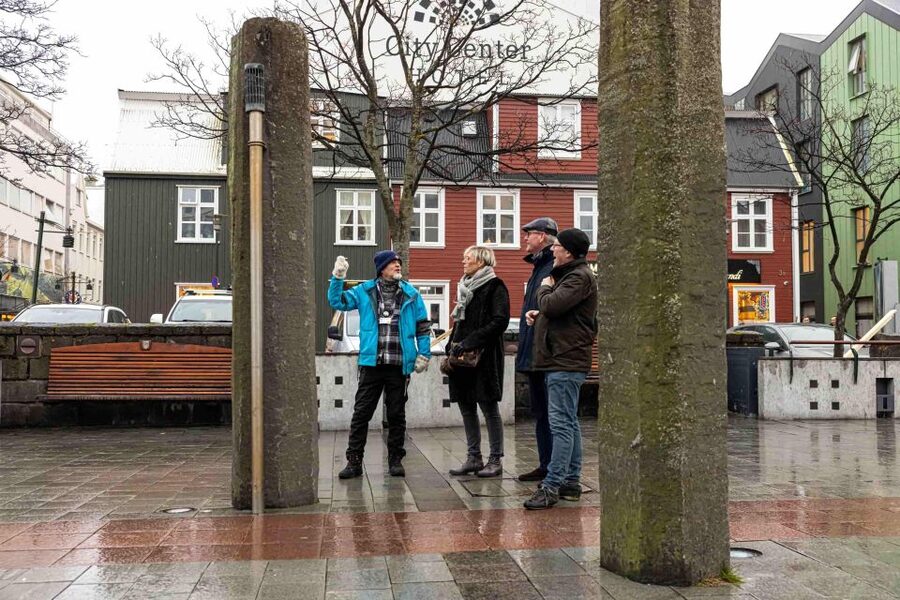
The walk begins at Ingolfur Square, in the center of Reykjavik. Your guide waits near the two stone high-seat pillars. The square sits where Austurstraeti begins, surrounded by Adalstraeti, Hafnarstraeti, Veltusund, and Vallarstraeti.
That location is convenient if you are already exploring downtown. From Laugavegur, Reykjavik’s main shopping street, continue downhill until you reach the square. The central meeting point also makes this a useful first-day activity, since you begin learning the city’s layout while hearing its legends.
Give yourself enough time to find the pillars. The meeting place is not a large indoor visitor center, and Icelandic weather can make standing around less pleasant than expected. Wear a waterproof outer layer and shoes with a good grip. The route is in the city, but you will spend the whole tour outdoors.
The tour ends at Austurvollur, close to the starting area. That makes it easy to continue with dinner, visit another central sight, or walk back to your hotel.
Ingolfur Square and the first tales
The opening stop introduces Reykjavik through stories rather than a long list of dates. Here you begin to hear how Norse mythology, Icelandic saga traditions, and local folklore overlap.
This is also where the tour sets its tone. The stories can shift quickly from funny to eerie. One moment you may be hearing about hidden people or the unusual number of Santas in Iceland, and the next you may be listening to a ghost tale.
The 13 Yule Lads are one of the memorable subjects. Iceland does not settle for one Santa Claus. It has 13 mischievous figures, each with a place in the Christmas season, plus their mother, Grýla, a troll who eats children. This is a good example of how Icelandic folklore can be playful and unsettling at the same time.
The tour also places these stories alongside modern Reykjavik. That contrast helps. You are not hearing about a distant fantasy world. You are standing in a working city where old beliefs remain part of the cultural conversation.
Two old graveyards and Reykjavik’s ghost stories
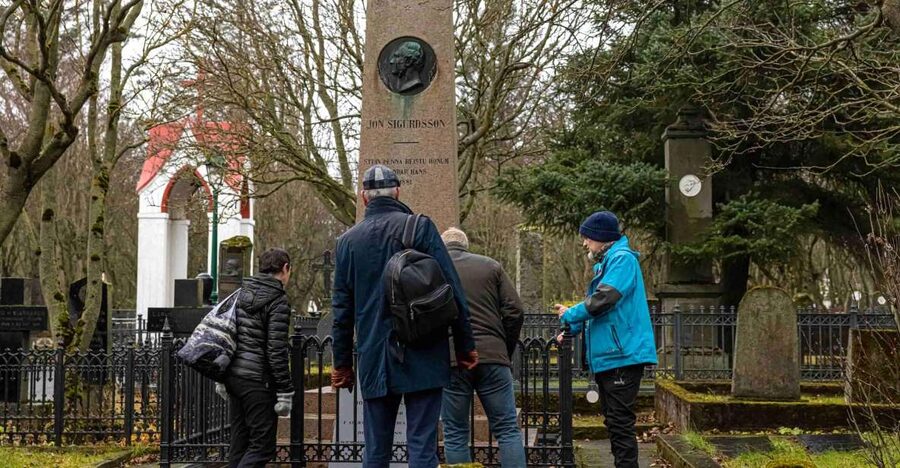
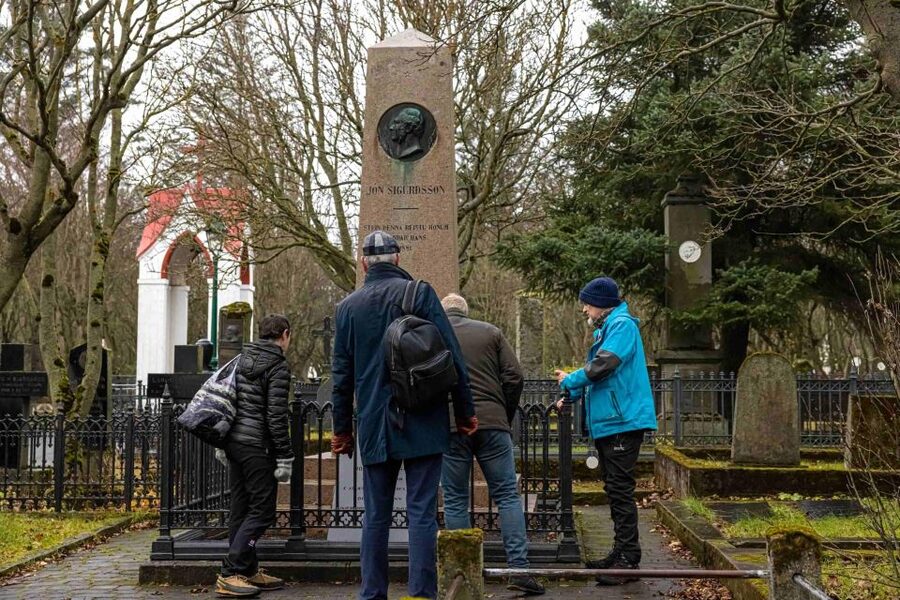
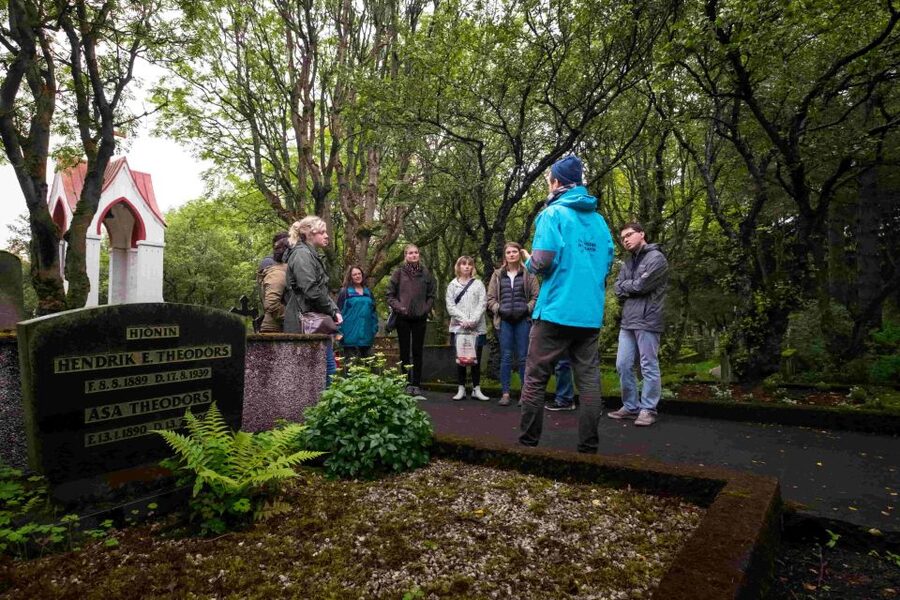
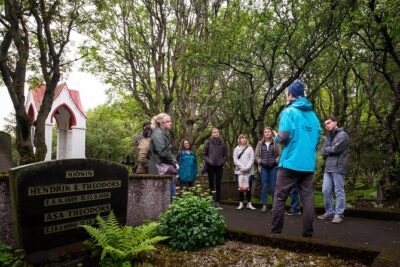
The cemetery portion gives the walk its strongest atmosphere. The route visits two of Reykjavik’s oldest graveyards, including Kirkjugarðurinn við Suðurgötu. Here the city becomes quieter, and the focus shifts toward death, ghosts, memory, and the stories people tell after dark.
The graveyards are especially important if you enjoy ghost walks. The tour includes the tale of the Deacon of the Dark River, one of the more unsettling figures in Icelandic folklore. The story is often performed rather than simply recited, and a good guide can make a short stop feel surprisingly tense.
That said, this is not a horror attraction with actors jumping out at you. The fear comes from the old stories, the cemetery setting, the guide’s voice, and the imagination. One guide may use physical comedy, while another may build a slower, darker mood.
For families, think carefully about your child’s tolerance. The tour description specifically warns that some stories may scare younger children. Private walks are available, and the material can be toned down for a family that wants the folklore without the more disturbing scenes.
The cemetery stops also give you a break from the faster pace of central Reykjavik. You can look at the surroundings and consider how storytelling once helped people pass long winter nights. In a place with limited daylight during winter, spoken tales were not a side activity. They were a main form of entertainment.
A few more things to do in Reykjavik worth a look
- Reykjavik: Whale Watching Tour with Expert Guide
★ 4.2 · 2,307 reviews - The Golden Circle Guided Bus Tour from Reykjavik
★ 4.5 · 1,726 reviews - From Reykjavik: Best of Golden Circle Guided Tour
★ 4.8 · 1,646 reviews - Northern Lights Guided Bus Tour from Reykjavik
★ 4.0 · 1,183 reviews
The Catholic Cathedral and Icelandic belief
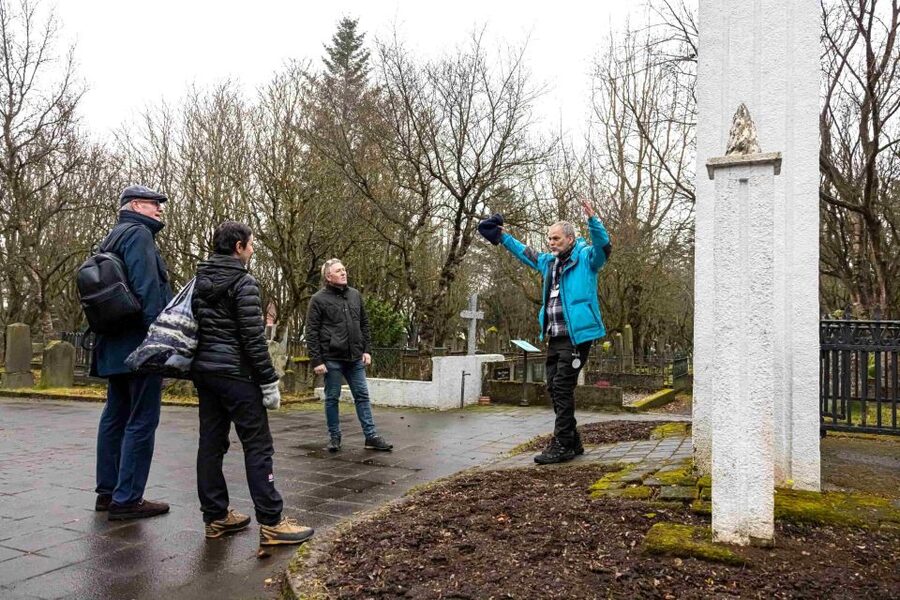
The Cathedral of Christ the King, Reykjavik’s Catholic Cathedral, adds another layer to the walk. Icelandic folklore is often linked with Norse mythology and pagan traditions, but the country’s religious story did not end there.
The cathedral stop helps show how different belief systems meet in Iceland. The guide may connect Christian ideas, older Norse tales, saints, spirits, and local customs. This is useful context because Icelandic folklore is not one neat category. It includes pre-Christian stories, Christian influence, family tales, ghost lore, and newer interpretations of old creatures.
The building also changes the mood of the route. After the graveyards and ghost stories, a church setting gives the group a different way to think about belief and tradition. You are not visiting for a formal interior tour, so do not expect an extended architectural presentation. The value lies in the cultural connections made by the guide.
This is one reason the walk works better than reading a list of Icelandic creatures in a guidebook. The places give the stories a sense of location, even when the subject is magical.
Lake Tjornin and Iceland’s monsters
Lake Tjornin brings the tour close to water, which is fitting because Icelandic folklore includes many creatures that live in or near the sea and lakes. The stories here are not limited to elves and trolls. You hear about strange, mostly aquatic monsters and Iceland’s own answer to the Loch Ness Monster.
This section is often lighter and more playful than the graveyard stop. A guide may show a convincing video, explain local monster traditions, or invite you to decide where fact ends and fiction begins. It is a good place for questions, especially if you are curious about how modern Icelanders treat old legends.
Lake Tjornin also gives you a more open setting after the narrow central streets and cemetery paths. The walk remains urban, but the water makes the stories feel less confined. You can see why Icelandic folklore has so many creatures linked to remote places, dark water, lava fields, and rough weather.
Do not expect a nature excursion here. This is still a city walk. The lake is used as a setting for storytelling, not as a long scenic stop.
Austurvollur, runes, and Icelandic magic
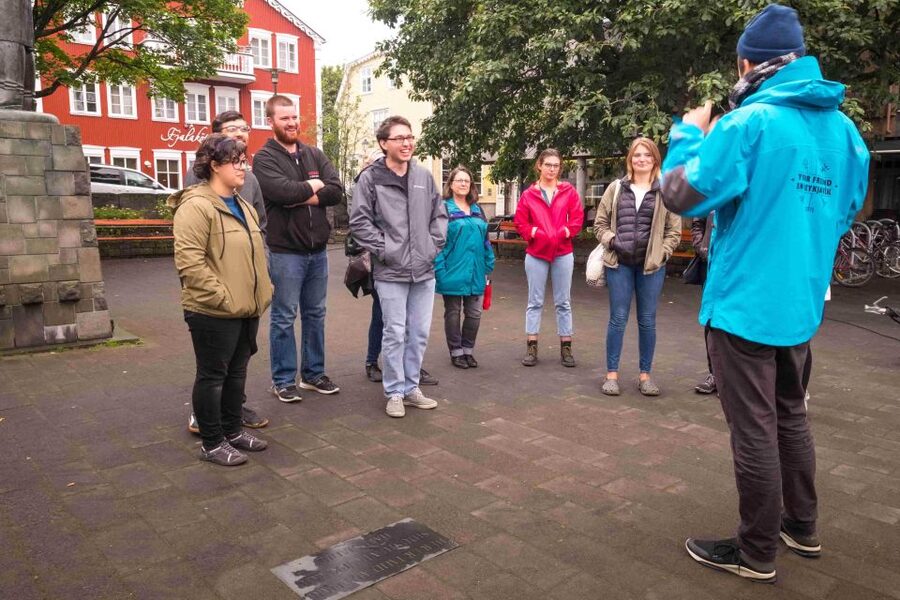
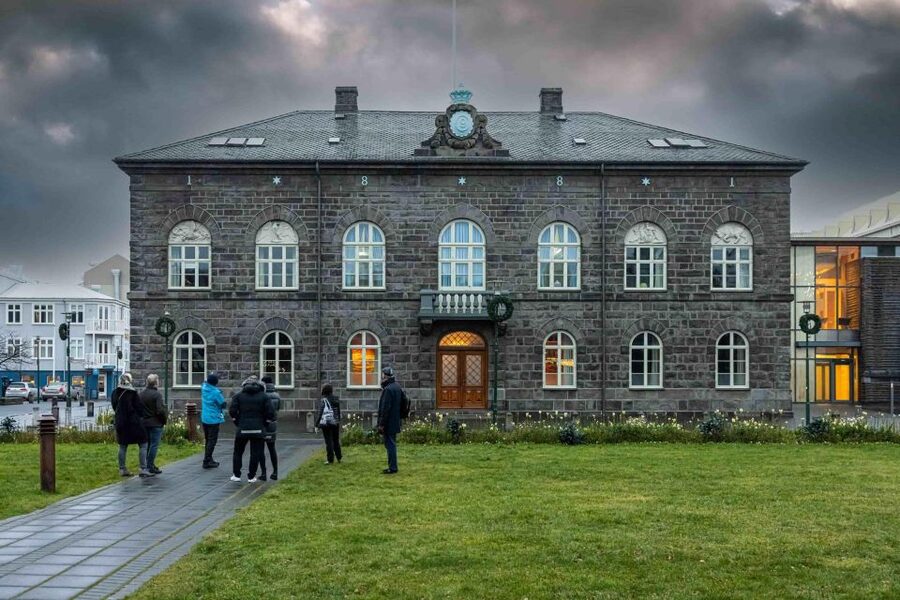
The final part of the route returns to Austurvollur. Here the guide introduces Icelandic magic and the runes of old. This gives the tour a useful ending because it moves beyond creatures and ghosts into the tools people once used to understand or influence the world around them.
The magic section is best approached as cultural folklore rather than a practical lesson. You may learn about symbols, spells, and the place of runes in old traditions. Some guides make this interactive, which helps the information stick.
The final stop also works as a recap. By now, the tour has covered hidden people, trolls, ghosts, monsters, Christmas figures, Norse mythology, magic, and the way stories pass through families and communities. It is a lot for 1.5 hours, but the short format keeps the experience from becoming a heavy mythology class.
Austurvollur is a practical finish. You are not left at an unfamiliar edge of town. You can continue sightseeing in central Reykjavik or walk back to the square where you began.
What makes the guides memorable
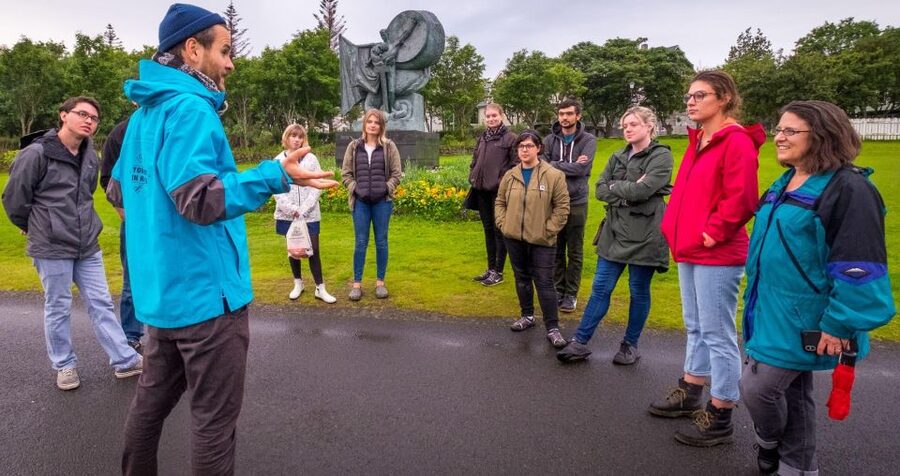
The strongest praise for this tour centers on the guides’ delivery. That matters more here than it would on a simple sightseeing route. Folklore depends on voice, expression, timing, and the ability to make a familiar street feel slightly strange.
Einar is frequently singled out for his enthusiasm, humor, singing, and ability to connect old tales with Icelandic composers, lullabies, family stories, and local traditions. Stefan has been praised for comic timing and clear storytelling. Magnus brings humor, while Oli is described as warm and informative.
You may instead be led by Beau, Bo, or another member of the team. The exact guide is not guaranteed, but the format allows room for personality. That is a good thing, though it also means the tone may vary. One guide may lean into ghosts, another into family folklore, and another into history and Norse mythology.
The language options are English, Spanish, and French. If English is not your first language, remember that the tour depends on listening closely to stories and wordplay. The content remains accessible, but some jokes and fast sections may be easier for confident English speakers.
Is $51 a fair price?
At $51 per person, this is not the cheapest way to walk around Reykjavik. You are paying for a live storyteller, a planned route, local folklore, and the added context that turns ordinary places into meaningful stops.
The value is strongest if you would otherwise book a ghost tour, a folklore talk, and a short city orientation separately. In 1.5 hours, you get a compact introduction to several sides of Icelandic culture. You also avoid spending half a day on a longer excursion when your schedule is tight.
The price is less appealing if you only want major landmarks or a detailed architectural tour. The Cathedral, lake, squares, and graveyards appear as settings for stories, not as long-form sightseeing lectures.
I would book it early in an Iceland visit. The stories can help you notice references to trolls, elves, sagas, Christmas traditions, and local beliefs during the rest of your stay. Several guides also answer questions about Iceland beyond the planned tales, including mountains and local customs.
The booking terms are flexible: you can cancel up to 24 hours before the tour for a full refund, and you can reserve now and pay later. The walk is wheelchair accessible, and private groups are available.
Who should take this walk?
You should consider it if you enjoy:
- Ghost stories that are atmospheric rather than theatrical
- Norse mythology and the world behind The Lord of the Rings
- Local customs, Christmas traditions, and oral storytelling
- Short walking tours with plenty of personality
- Unusual city activities that go beyond the main sights
- A first introduction to Reykjavik that mixes culture and entertainment
It is particularly good for solo visitors because the guide provides an easy shared activity without requiring a full-day commitment. Couples and older children may also enjoy the playful mix of humor and suspense.
I would be more cautious with very young children. The stories about ghosts, death, trolls, and Grýla can be upsetting, especially after dark or in a cemetery. Ask about a private version if you want the same subject with a gentler tone.
Weather, clothing, and timing
Icelandic weather is part of the practical calculation. The tour continues in rain and snow, so bring weather-appropriate clothing rather than relying on a warm indoor layer alone. A waterproof jacket, hat, and shoes suited to wet pavement are sensible choices.
The official duration is 1.5 hours. That is long enough to cover the main stories but short enough to fit around a museum, meal, or evening plan. Starting times vary, so check the schedule before booking.
Because the tour is on foot, you should also consider how you feel in cold or windy conditions. There is no bus between stops and no indoor shelter built into the route. The weather can add atmosphere, but only if you are dressed for it.
Should you book the Reykjavik Folklore Walking Tour?
Book it if you want stories with a sense of place, not just a checklist of Reykjavik sights. The graveyards, cathedral, lake, elfstone, and central squares give the guide plenty to work with, while the tales of trolls, ghosts, monsters, Yule Lads, and Icelandic magic keep the walk lively.
Skip it if you prefer a strictly factual city tour, dislike spooky subjects, or need a fully indoor activity. For most curious visitors, though, this is a useful early-stay choice. It gives you a better feel for how Icelanders connect landscape, belief, humor, family stories, and the long dark season.
At $51, it earns its price through performance and local color. Choose it for the storytelling, dress for the weather, and remember that the quiet cemetery stop may be more frightening than the playful elf tales.
FAQ
How long is the Reykjavik Folklore Walking Tour?
The tour lasts 1.5 hours. Check availability for the specific starting times.
Where does the tour begin?
Meet at Ingolfur Square in central Reykjavik, near the two stone high-seat pillars. The square is at the start of Austurstraeti.
Where does the tour finish?
The walk finishes at Austurvollur, in the central Reykjavik area and close to the starting point.
What languages are available?
Live guides are available in English, Spanish, and French.
Is the tour suitable for young children?
Some stories may be scary for younger children. The tour includes ghosts, trolls, monsters, and Grýla, a child-eating troll. A private walk can be arranged with the scariness reduced.
Is the walk wheelchair accessible?
Yes, the activity is listed as wheelchair accessible. Weather-appropriate clothing is recommended because the tour takes place outdoors.
Just added in Reykjavik
- 2-Day South Coast, Blue Ice Cave, Glacier Lagoon Tour★ 5.0 · 4 reviews
- 1-Hour Helicopter Tour in Iceland: The Geothermal Tour★ 4.9 · 263 reviews
- Reykjavik: Countryside Guided ATV Tour with Transfers★ 4.8 · 272 reviews
- Midnight Sun ATV Adventure from Reykjavik★ 5.0 · 112 reviews
- 8-Day Iceland Ring Road Tour: Reykjavik, Akureyri, Golden Circle & South Coast★ 4.5 · 81 reviews
- Helicopter Tour with Mountain Summit Landing from Reykjavik★ 5.0 · 243 reviews
- Magical Whales in the Midnight Sun | from Reykjavik★ 4.5 · 91 reviews
- Iceland Volcanic Eruption Area Helicopter Tour from Reykjavík★ 4.5 · 196 reviews
Reykjavik Walking & Food Tours, compared.
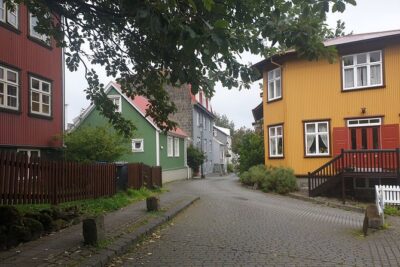
Reykjavík Small group Walking Tour – by CityWalk
Read our review →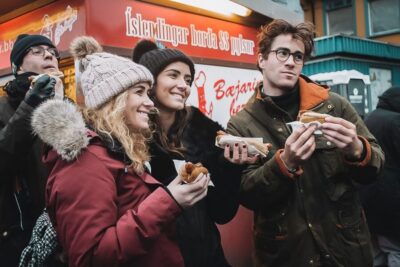
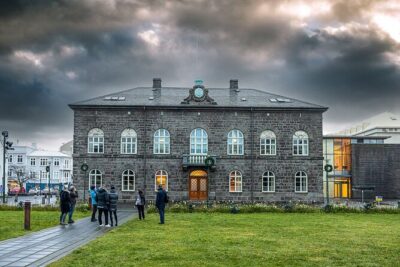
Reykjavik Folklore Walking Tour: Meet the Elves, Trolls & Ghosts of Iceland
Read our review →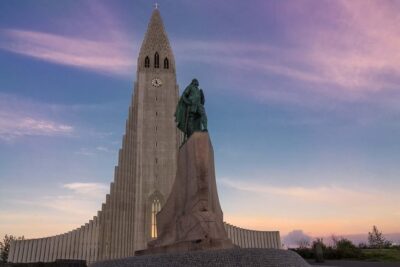
Funky History Walking Tour in Reykjavik – With local storyteller
Read our review →
City Walking tour in Small Group with Local Guide
Read our review →Browse the lists this tour appears in